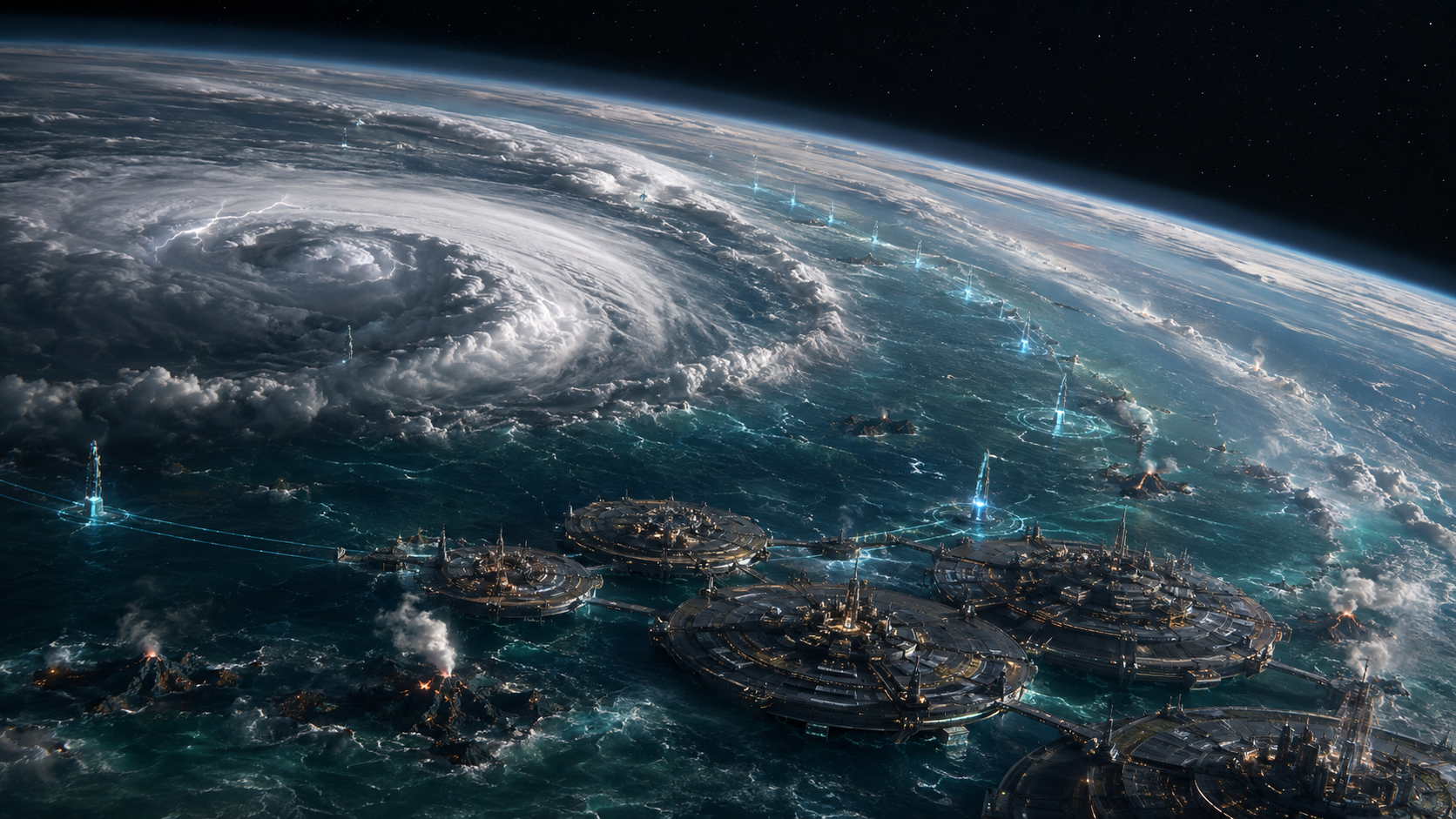
The Greywake Stations
Infrastructure
The Greywake Stations keep watch over Talassar’s storm belt, turning deep-ocean observations into trained pilots, route warnings and rescue launches, and into refuge.
Overview
The Record
The Greywake Stations stand where Talassar’s long day drives severe weather across a dangerous stretch of open water. Each fortified platform watches pressure and current, cloud and wave from behind armored foundations and enclosed galleries. Reports from vessels already in the weather are checked against the sensors. Then they become route broadcasts and pilot instructions, and the decision to close the corridor or open it again.
A station changes purpose as conditions worsen. Training decks clear, rescue craft launch, and protected berths take in vessels that can no longer reach a harbor wall. Civilian captains need no prior agreement to claim refuge. Once inside, they answer to station command until released. The lower structures may be lost to salt and heavy seas. Shelters and communications, and the means to recover crews, are kept in duplicate.
No court owns the whole chain. Rival maritime governments, captains’ institutions and weather offices send their own crews and material under a compact that binds them to share observations and rescue warnings. They may still fight over tariffs, cargo and prestige elsewhere. At Greywake, holding back a forecast counts as sabotage. The stations can keep a common watch because they never ask Talassar’s courts to accept a common ruler.
Role and Purpose
Function
Greywake observes the weather of the terminator and studies how it develops. It trains and certifies weather-readers and pilots, broadcasts route conditions and launches rescues. It also shelters vessels caught beyond a harbor wall.
Authority and Civic Life
Governance
Several maritime courts, captains’ institutions and weather offices keep the chain going by compact. Each station commands its own crews, berths and local work. All of them must share observations, warnings and rescue duties. The compact makes a common service. It does not make a government over the courts that take part.
Landscape and Conditions
Environment
Armored foundations built to break waves carry sensor towers and enclosed command galleries, rescue hangars and training decks, in deep ocean beside a recurring storm belt. Protected berths and duplicate shelters sit among them. Salt, wind and heavy seas are losses everyone expects, so the exposed lower structures are built to be replaced.
Arrival and Transit
Travel Notes
Pilot cutters and rescue craft are the usual way in. Atmospheric transport lands only when conditions allow. Any civilian vessel may claim emergency shelter without prior agreement, but station command governs the berth until the corridor reopens. A closure means the route around is unsafe. It does not mean an unwatched way has opened.
Dawn and Gloam